Drywall Repair in Seaford, NY
Cracks along the seam where an addition meets the old house, holes left behind by the electrician, a coffee-colored blotch up on the ceiling: each one patched, worked into the surrounding finish and handed back primed for paint.
Call 7 days, 7am–9pm
Call or write, and the area drywall contractor pricing your job rings back to go over the damage and line up a quote.
Small jobs are fine. A quote comes before anyone opens a bucket of mud.
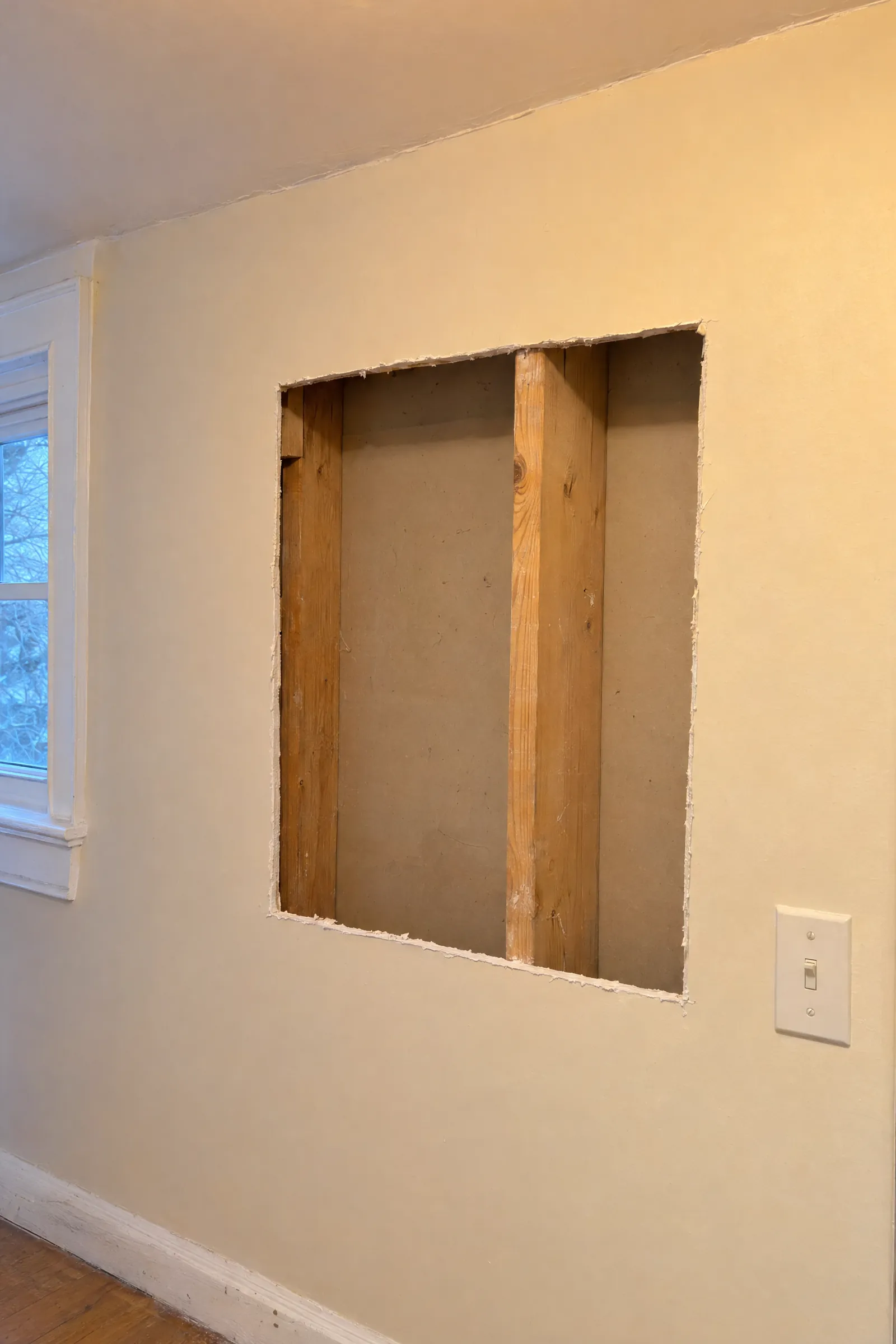
01 Four kinds of wall trouble, sorted
Seaford Drywall Repair books drywall repair and sheetrock repair for houses across this South Shore hamlet; how a request turns into a finished wall is spelled out on the about page. Pick the line that sounds like your wall.
- Cracks at addition and dormer seams
- Cracks that run along the joint where a dormer, a second story or a rear addition meets the original walls, taped and bedded again so the old floor plan stops showing through.
- Patching after a renovation
- Access holes from electricians and plumbers, old fixture boxes, shelf anchors and the doorknob that finally won, closed with new board and feathered compound.
- Stained and sagging ceilings
- Brown rings and soft spots under bathrooms, roofs and attic lines, repaired after the leak is dealt with and the board behind the stain is dry.
- Blending wall and ceiling texture
- Knockdown, popcorn, skip trowel and orange peel rebuilt over a patch so it blends into the field of the wall.
02 Garages, basements and the board nobody looks at
Garage-to-house walls
Building codes treat the partition separating a garage from the rooms beside or above it as a fire barrier, and the board there is often thicker, fire-resistant Type X. A hole in it should be closed with board of matching kind and thickness, not the half sheet of regular board leaning in the corner. Ask the pro what is in the wall before the patch goes in.
Basement board that drinks from the floor
Drywall set tight to a concrete slab wicks up water and shows it as a dark band along the bottom. A proper repair cuts the wet section out above the line, uses a moisture-resistant board for the new piece and stops it just shy of the floor, with the base trim covering the gap. Drywall, it turns out, is a sponge with paper on both sides.
Bumpers, bikes and outside corners
Garage walls take hits from car doors, handlebars and anything carried in sideways. Dented metal corner bead is removed and a new length goes on rather than being filled, because a filled dent in bead cracks again at the next knock.
When waiting is the smart call
After a leak or a flood, the studs and the board both need to dry out before any new board goes on. In Seaford Harbor, south of Merrick Road, Hurricane Sandy flooded the canal streets in 2012; one Alcona Street resident told the Herald it reached the bottom of his front door and caved in his garage doors. A wall patched while still damp traps that water inside it, so a moisture reading comes first.
03 Point at the problem
Choose the one closest to your wall. The scheduling page opens with it already picked, so all that is left is who you are, how to reach you and a sentence about the wall.
04 What pushes the price up or down
For a rough national reference, the Homewyse drywall repair calculator put the estimated national average for a basic drywall repair at $297 to $472 per repair in May 2026, and its estimate builds in a four-hour minimum labor charge. Treat it as a national yardstick, not a Seaford price. Your quote is worked out by a nearby pro once they know what the wall needs, and it moves with these:
- Size and count
- One dinner-plate hole and three nail pops in the same room can price close together, because setup and drying time do not shrink with the hole.
- Wall or ceiling
- Working over your head takes longer and makes more mess. A ceiling patch usually needs more coats to hide when sun from a window skims across it.
- Reach
- Stairwells, sloped dormer ceilings and tall foyers need staging and more time to set up safely.
- Texture
- A smooth wall needs a careful skim. Knockdown, orange peel and popcorn need a sample and a blend, which adds a step.
- Moisture
- Wet board means drying, cutting out more than the stain and blocking the ring before paint.
- Paint
- A patch primed and left for you to paint costs less than one painted corner to corner so the sheen matches.
05 Five things to note before dialing
- Two photos, one wide and one close. Lay a quarter or a folding rule next to the damage in the close one so the size is obvious. Those are the photos to send as a snapshot.
- The longest side of the damage. An inch, a hand, a forearm. Rough is fine.
- Anything that should be off. If water is still dripping, close the valve that feeds it. If water has a ceiling bulging, flip the breakers feeding the lights and fans in that stretch first, then empty the room beneath.
- The finish. Smooth, sprayed, swirled or popcorn, and whether there is leftover paint with a label on the can lid.
- When it showed up. A crack that appeared the winter after an addition went on tells a different story from one that has been creeping for a decade.
06 Two parts of Seaford, two kinds of wall trouble
Seaford Harbor, south of Merrick Road
The canal streets here took Tropical Storm Irene in 2011 and Hurricane Sandy in 2012. By 2016 the Herald reported that homes in the neighborhood had been raised, others completely remodeled and some torn down and rebuilt. A raised or rebuilt house tends to have new board meeting old trim and old framing settling against new, which shows up as cracks at corners and along long seams, plus the odd patch over board that once got wet low on the wall.
The blocks around Sunrise Highway and the station
The Seaford stop on the Babylon Branch sits where Sunrise Highway crosses Jackson Avenue. Sunrise Highway came through in 1929, and Seaford's population of roughly 1,200 tripled within a quarter-century. Houses from that growth have had a long time to settle and a long line of owners to rearrange them, so it is no surprise to find patched-over doorways, moved outlets and old fixture boxes behind the paint.
07 Seaford plus the South Shore towns beside it
Seaford. Seaford, NY itself, a Town of Hempstead hamlet between Wantagh and Massapequa, from the canals by the bay up past Jerusalem Avenue.
Wantagh and North Wantagh. Right next door to the west and north; Wantagh became a suburb with the housing built from the 1950s into the 1970s.
Massapequa and Massapequa Park. Over the line in the Town of Oyster Bay, to the east.
Bellmore and Levittown. A little farther west and north, both a short drive away.
Each one gets its own note on the list of towns covered.
08 A short read before you look up
Stains, sags, a crack that opens every winter where the ceiling meets a wall, popcorn texture and tape lines that ghost through the paint all mean different things. The ceiling problems guide walks through each one, what usually causes it and which ones should not wait.
09 Keeping the dust where it belongs
Floors
Drop cloths over carpet, and paper taped down over hardwood so grit cannot work under the cloth and scratch the finish.
Furniture
Anything that can move gets moved a few feet back. What cannot move gets covered in plastic.
Vents
Supply and return grilles near the work get closed and covered, and it helps to switch the heat or air off while sanding. Gypsum dust has never met a vent it did not like.
Doorways
For bigger cut-outs, a plastic curtain with a zip door keeps the rest of the house out of it. Ask for a vacuum-attached sander or wet sanding on ceilings; both cut the cloud down a great deal.
10 Ceilings, where gravity gets a vote
Tea-stain rings
A brown ring is dried water. Its source has to be found and stopped, then the ring sealed under a blocker, since ordinary paint lets it bleed through again.
Sagging
Board that sags between joists has either soaked up water or lost its fasteners. Wet sags get cut out. Dry ones can sometimes be screwed back up, if the board is still firm.
Winter cracks at the wall line
Where an inside partition meets the ceiling, a gap showing up in January and shutting by July is often truss uplift: the roof framing flexing with the seasons. It gets a flexible fix, not more tape.
Popcorn and seams
Older popcorn texture may hold asbestos, so a sample goes to a lab before anybody disturbs it. Long tape lines running dead straight overhead are joints showing through the paint.
For leaks and soft spots overhead, see how ceiling stain repair works.
11 Small, medium and the other kind
- Small
- Nail pops, anchor holes, a dent from a chair back, holes up to a few inches. Filled or backed with a small patch, two or three thin coats with drying in between, sanded and primed. Often a short visit to patch and a second to finish.
- Medium
- Doorknob holes, electrician cut-outs, a missing outlet box. A new square of gypsum screwed to blocking or a stud, taped, three coats, texture if the wall has any. Paint follows after the final coat dries and takes primer.
- Large
- A ceiling section after a leak, a seam that runs the whole length of a dormer, a wall opened for plumbing. Whole sheets or long runs replaced, sometimes insulation too, more drying time and usually paint on the full wall or ceiling so the sheen evens out.
12 Keeping a paper trail after water or a knock
Pictures first, cleanup second
Wide shots of the room, close shots of the stain or hole, and the source if you can see it: the drip under the tub, the bent ceiling vent, the doorknob that did it. Your phone stamps the date.
Write down the timeline
When you first noticed it, when the water was shut off, who came to stop the leak. A few lines in an email to yourself works.
Keep the paper
Plumber and roofer invoices, receipts for fans or dehumidifiers, and the written repair quote.
Renting?
Send the photos to the landlord or manager in writing so there is a record of when they knew. What a policy or a lease covers is between you and them; the goal here is a clear file.
13 Tell us which wall, and we take it from there
- Call or send a snapshotPhone during call hours, or message a picture plus a line about what happened.
- A local pro calls backThey ask what a picture cannot answer and pick a time to price the job.
- Quote firstYou see the price and the plan before any work starts.
- Finished and blendedThe repair is closed, textured to match and left primed for paint, or painted if that is in the quote.
Either route, the contractor who will quote the drywall phones back to walk through the damage with you before any quote is written.